Grains July 10th

Corn • Soybeans • Wheat

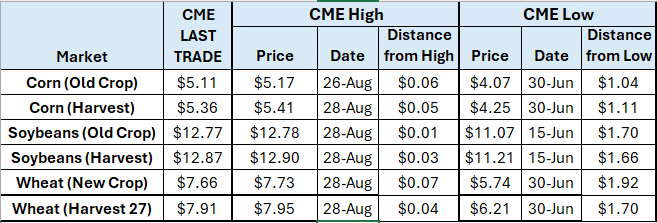
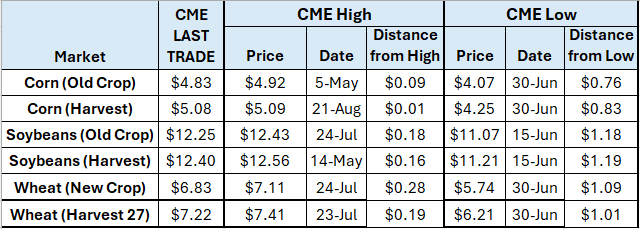
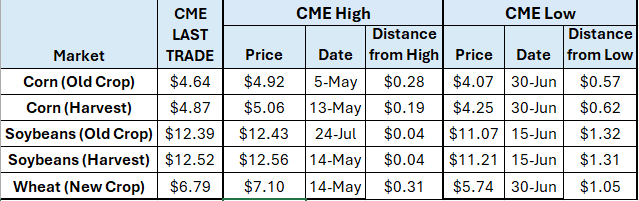
Boosted by the USDA Production Report Friday afternoon closed higher on the week. Wheat and Soybeans made the largest moves this week, both ending up 0.39, while corn ended the week up 0.13. Major headlines over the last week were lead by Brooke Rollins announcing the EU will be removing/reducing tariffs on US Agricultural products. This was sparked by poor growing conditions, most notably France having their worst corn crop in a decade.  

 Corn

Corn futures rallied into the close, with Dec corn near $4.60. The market has added weather premium as forecasts call for hotter and drier conditions across parts of the Midwest during the key July pollination window. Corn has pulled back from a one-month high earlier in the week as traders took profits ahead of USDA’s WASDE, but weather concerns and stronger energy markets continued to support the broader tone.

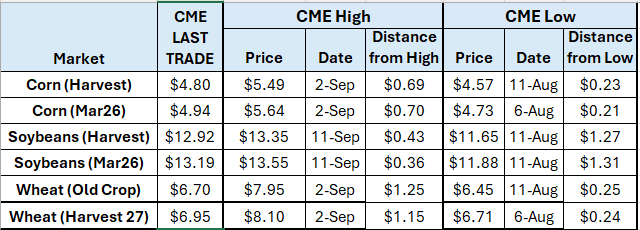
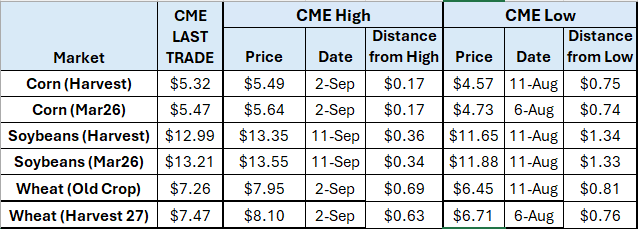
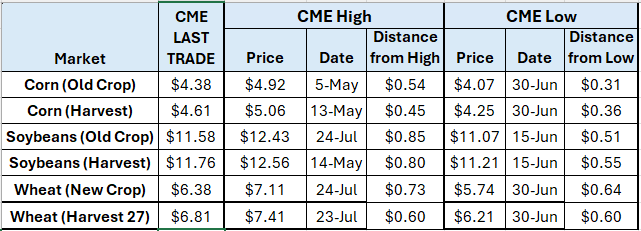
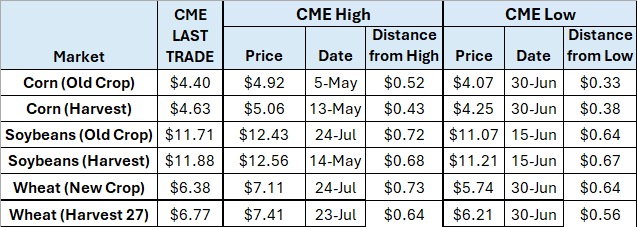
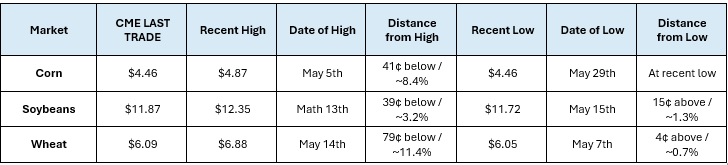
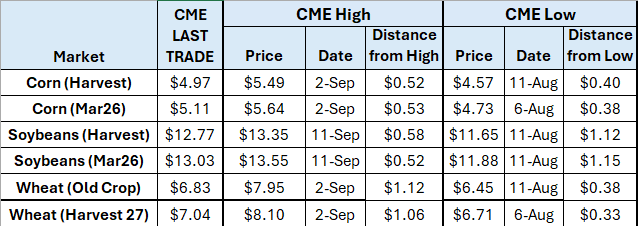
Farmer takeaway: New crop corn is sitting 35¢ above recent lows but still 45¢ away from recent highs. Setting price targets and disciplined selling will be key through this growing season.

Soybeans

Soybeans continue to show improving momentum, with Nov futures closing near $11.90. The market received  support by renewed China buying interest, including multiple USDA-reported soybean sales to China and unknown destinations, though traders still want to see more sustained demand.

Farmer takeaway: Soybeans took a major jump on Monday, gaining back 37¢, now only 24¢ from recent highs. Incremental sales using targets will provide opportunity to capitalize on any upside move in the market.

Wheat

Wheat harvest has officially made its way to NY this week as the first loads have started to make their way from fields. The market is sitting near the median point between recent highs and lows, ending the week by gaining 20¢ on Friday.  

Farmer takeaway: As wheat harvest begins, make sure to watch for quality as NY wheat has lived through a strenuous life-cycle. Take advantage of harvest market rallies and get your needs booked at profitable values.  

What We’re Watching Next

·         ·  Weather: Corn pollination risk and soybean development now dominate daily trade direction.

·         ·  Exports: China soybean buying and corn export demand need continued confirmation to extend the rally.

·         ·  Outside markets: Crude oil, soybean oil, the U.S. dollar, freight, and fertilizer costs remain key to futures and local basis.

Marketing Thought

The market has improved, but volatility remains high. Use strength to make disciplined incremental sales, keep target offers working. Corn has more room to recover, soybeans are approaching recent highs, and wheat has rallied sharply into harvest-season uncertainty.

Contact our merchandising team for current bids, basis levels, and contract alternatives.

Futures and basis are subject to change. This update is for informational purposes only and is not a recommendation to buy or sell futures or cash grain.
Grains June 2nd

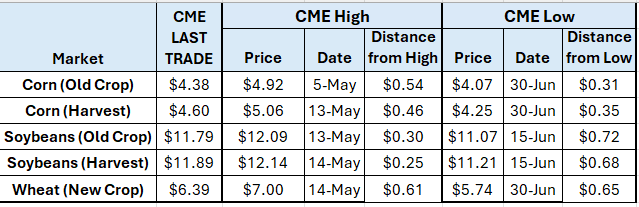
Grain markets will be closed Friday July 3rd in observance of the 250th celebration of the USA on the 4th. Markets have been trying to stabilize after the late-June selloff, helped by post-USDA-report short covering, weather uncertainty, and renewed demand chatter; however, futures are still trading well below spring highs.

Corn has bounced off the late-June lows, but the market remains defensive overall. USDA’s June 30 Acreage report showed corn planted area at 95.343 million acres, with stronger ethanol production also helping support nearby sentiment.

Farmer takeaway: Corn is still much closer to the recent low than the spring high. If futures continue to improve, consider rewarding strength with incremental sales rather than waiting for one large rally.

Cash Targets: Old Crop: 4.75 New Crop: 4.55

Soybeans

Soybeans have also recovered from recent lows, supported by short-covering, stronger product markets at times, and talk of renewed export interest. Soybean futures gained on July 1st, sparked by the USDA’s June Acreage report estimate of 85.36 million soybean acres.

Farmer takeaway: Soybeans are holding up better than corn on a relative basis, but the market remains well below May highs. Keep firm target offers working above the market.

Cash Targets: Old Crop: 11.65 New Crop: 11.45

Wheat

SRW wheat has stabilized near the $6.00 area after a volatile June. Wheat rallied after USDA reports trimmed U.S. wheat acreage and tightened the balance sheet, but harvest pressure and global supply competition continue to cap rallies. The U.S. wheat balance sheets tightened after acreage reductions, while also pointing to export competition and Black Sea uncertainty.

Farmer takeaway: Wheat has bounced but remains incredibly vulnerable to harvest pressure. As harvest season locally rapidly approaches, be sure to have a plan for bin space needed, and be aware of quality.

Cash Target: New Crop: 6.20

What We’re Watching Next

  • Weather: Heat and moisture forecasts will drive corn and soybean direction as July pollination and early reproductive stages approach.

  • Exports: Thursday export sales will be key, and any confirmed China buying will be important for soybeans and corn will provide a needed spark.

  • USDA follow-through: The market is still digesting the June 30 Acreage and Grain Stocks reports, with the next WASDE scheduled for July 10.

  • Outside markets: Crude oil, soybean oil, the U.S. dollar, freight, and fertilizer remain important drivers of futures and basis.

Marketing Thought

The recent bounce is encouraging, but futures remain closer to recent lows than highs. Use rallies to make disciplined sales, keep target offers working, and stay focused on basis opportunities.

Contact our merchandising team to talk more in depth about our local market.

Futures and basis are subject to change. This update is for informational purposes only and is not a recommendation to buy or sell futures or cash grain.
Grains June 26th

Corn • Soybeans • Wheat

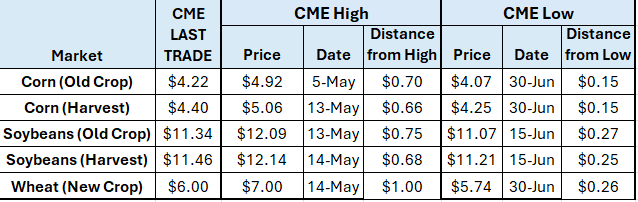
Grain markets bounced Thursday after testing recent lows earlier in the week. Corn and soybeans rallied on short-covering, export business, and a drier early-July weather outlook, while wheat posted modest strength but remains in a volatile harvest-season market. Even with Thursday’s bounce, all three markets remain well below recent highs and are still trading closer to the low end of the recent range than the high end.

Corn

Corn futures finished the week nearly 5 cents lower of where it opened Monday. USDA reported old-crop corn export sales at 743,097 MT for the week ending June 18, with Mexico the top buyer, while new-crop business was more than double the same week last year. Some analysts are showing the possibility of dryness hitting the corn belt in July which could give us market support if funds deem it cause for concern.

Farmer takeaway: Corn is still only modestly above recent lows. If futures firm further, consider pricing into the rallies with incremental sales, especially on any old crop left in the bin.

Soybeans

Soybeans also bounced Thursday, helped by short-covering, weather concerns, and strength in soybean products. Even with the rebound, soybeans remain well below recent highs. July soybeans settled at $11.24, about 96¢ below the recent high near $12.20, but only 22¢ above the recent low near $11.02½

Farmer takeaway: Soybeans are still above the recent low but well below mid-May highs. Watch for pricing opportunities and make you have coverage for this upcoming harvest.

Wheat

SRW wheat firmed Thursday, with contracts 4 to 5 cents higher at the close, but with much of the US harvesting, volatility took over and gave back 13 cents on Friday. USDA wheat export sales for the week ending June 18 were 504,489 MT, up from the prior week and nearly double the same week last year, with Mexico the top buyer.

Farmer takeaway: Wheat continues its pattern volatility as we move into our harvest season. Set price targets and make sure to watch quality.

What We’re Watching Next

  • Weather: Corn is 94% emerged and rated 68% good/excellent, while soybeans are 95% planted, 88% emerged, and 66% good/excellent; any turn hotter/drier or excessively wet will matter quickly as July approaches.

  • Exports: Corn and soybean export sales showed signs of life this week, including corn to Mexico and soybean sales to China/unknown destinations, but traders still want sustained demand confirmation.

  • Outside markets: A stronger U.S. dollar and weaker crude oil have weighed on grains and oilseeds because of export competitiveness and biofuel demand links.

  • USDA reports: The June 30 Acreage and Grain Stocks reports remain the next major scheduled market-moving events.

Marketing Thought

With futures still near the lower end of the recent range, basis, carry, and disciplined target orders matter. Corn is closest to its recent low, soybeans have pulled back sharply from spring highs, and wheat remains volatile with harvest and quality risk. Use rallies to reward the market in increments rather than waiting for one big move.

Contact our merchandising team for current bids, basis levels, and contract alternatives.

Futures and basis are subject to change. This update is for informational purposes only and is not a recommendation to buy or sell futures or cash grain.
Grains June 19th

Corn • Soybeans • Wheat

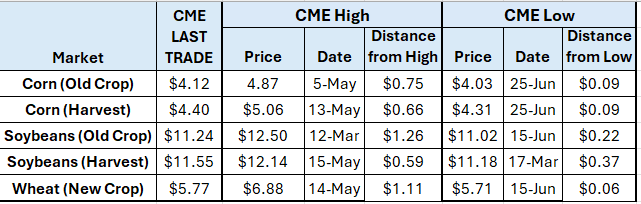
Grain markets backed off into the long holiday weekend, with corn, soybeans, and wheat all lower on Thursday. The tone remains defensive overall: corn is still near recent lows, soybeans have slipped after a midweek export-supported bounce, and wheat has pulled back from its recent rally while still holding above the early-June lows. Before the long traders weekend Economic trading showed weaker oil prices and a stronger U.S. dollar weighed on grains and oilseeds markets.

 Corn

Corn futures finished weaker into the holiday weekend, with losses of 3½ to 5¾ cents across most contracts and the national average cash corn price down 3½ cents. Export news was supportive — USDA reported a private sale of 285,775 MT of corn to Mexico for new-crop shipment, and weekly old-crop export sales were a four-week high — but the market still faded on broader weakness and positioning ahead of the long weekend.

Farmer takeaway: Corn remains close to recent lows. If futures bounce, consider using target offers or scaling in incremental sales, especially on old-crop bushels.

Soybeans

Soybeans also retreated Thursday, reporting losses of 6½ to 9¼ cents across the board and the national average cash bean price down 8½ cents. There was supportive export news, including USDA-reported private sales of 132,000 MT to China and 120,000 MT to unknown destinations for 2026/27, but weaker soybean oil and broader outside-market pressure limited upside follow-through.

Farmer takeaway: Soybeans are still above the recent low but well below mid-May highs. Keep firm offers working above the market.

Wheat

Wheat slipped lower into the break, with SRW contracts down 1½ to 7¼ cents at the close, though July wheat was still higher on the week. Weather remains a key driver: recent rains have supported parts of the U.S. crop but also raised harvest and quality concerns in some areas. While winter wheat ratings remain historically weak even after slight improvement. USDA’s latest crop progress data showed winter wheat 25% harvested and 27% good/excellent.

Farmer takeaway: Wheat bounced off its recent lows, but is still well off May highs. Make sure you have coverage for new bushels and are watching for pricing opportunities.

What We’re Watching Next

  • Weather: Corn is 94% emerged and rated 68% good/excellent, while soybeans are 95% planted, 88% emerged, and 66% good/excellent; any turn hotter/drier or excessively wet will matter quickly as July approaches.

  • Exports: Corn and soybean export sales showed signs of life this week, including corn to Mexico and soybean sales to China/unknown destinations, but traders still want sustained demand confirmation.

  • Outside markets: A stronger U.S. dollar and weaker crude oil have weighed on grains and oilseeds because of export competitiveness and biofuel demand links.

  • USDA reports: The June 30 Acreage and Grain Stocks reports remain the next major scheduled market-moving events.

Marketing Thought

With futures still near the lower end of the recent range, basis, carry, and disciplined target orders matter. Corn is closest to its recent low, soybeans have pulled back sharply from spring highs, and wheat remains volatile with harvest and quality risk. Use rallies to reward the market in increments rather than waiting for one big move.

Contact our merchandising team for current bids, basis levels, and contract alternatives.

Futures and basis are subject to change. This update is for informational purposes only and is not a recommendation to buy or sell futures or cash grain.
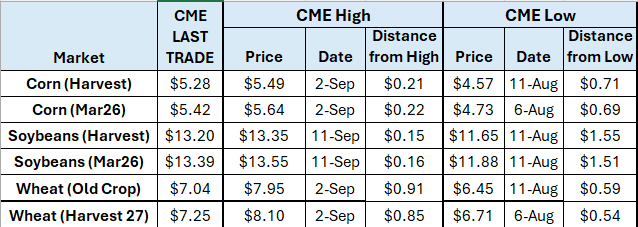
Grains June 12th

Corn • Soybeans • Wheat

Hedge funds have continued to take risk off shrinking what was a record long position as a vast majority of crops are now in the ground. Emergence continues to be strong, and conditions are showing optimal conditions as crop ratings are on the high side of previous years. Globally the South America 2nd crop corn is in full harvest and providing additional downward pressure as it comes to market.  


Corn

Corn futures had been down most of the week before rebounding off a new low Friday and having a strong finish to the week. Both the July and Dec futures had traded to new contract lows on Friday morning before finding support. USDA’s June WASDE still had a large 2026/27 U.S. crop at 15.9 billion bushels, down from last year but still historically large, with ending stocks projected at 1.957 billion bushels.

Farmer takeaway: Corn has been falling into the trend of making lower lows and lower highs. Know your estimated yield and make sure to reward any rallies the market may give now that we are in the post-planting window.

Soybeans

Soybeans traded in a relative sideways range this week with the USDA report providing no real push in either direction. USDA report for June showed no change in projected 2026/27 U.S. soybean production at 4.435 billion bushels, with no change in expected ending stocks. Soybeans are being driven heavily by headlines as we navigate international trade, domestic renewable fuel requirements, and crush margins.  

Farmer takeaway: Soybeans are still holding on in terms of price levels as we enter the summer. Calculate your personal production and make to lock in profit when the market gives that opportunity.

Wheat

Wheat was the relative bright spot after USDA trimmed U.S. wheat production. Chicago SRW stayed range bound which was a welcome change from trading lower the past month. USDA lowered projected U.S. wheat production to 1.543 billion bushels, which is the lowest production going back to the 1970’s. Plains drought losses, cut projected wheat ending stocks to 744 million bushels.

Farmer takeaway: Wheat has bounced slightly from recent lows but remains far below May highs. Watch harvest pressure, vomitoxins, and any selling opportunities.

What We’re Watching Next

  • Weather: Corn and soybean markets are trading favorable Midwest weather; wheat remains focused on harvest conditions and Plains drought impacts.

  • Exports: USDA raised corn export expectations but lowered soybean exports again, keeping demand questions front and center.

  • June 30 Reports: USDA’s Acreage and Grain Stocks reports are the next major market-moving events.

  • Outside markets: Crude oil, soybean oil, fertilizer, freight, and currency moves continue to influence futures sentiment and local basis.

Marketing Thought

With corn at a two-month low and soybeans/wheat only modestly above recent lows, basis and discipline matter. Keep breakevens updated, keep target offers working, and consider using futures or basis rallies to price incremental bushels.

Contact our merchandising team for current bids, basis levels, and contract alternatives.

Futures and basis are subject to change. This update is for informational purposes only and is not a recommendation to buy or sell futures or cash grain.
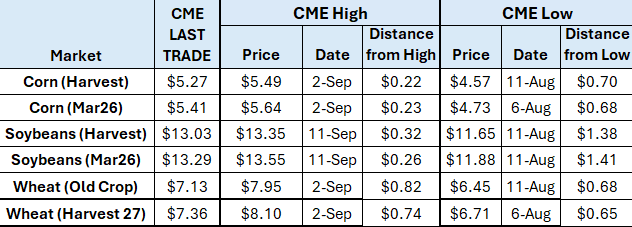
Grains June 5th

Corn • Soybeans • Wheat | June 5, 2026

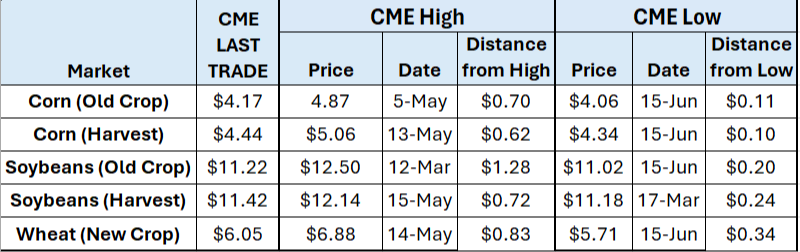
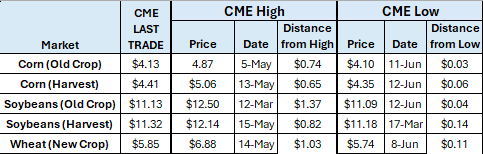
Grain markets started off in the month of June taking risk off as speculators are tapering off near record long positions. Steady planting progress and optimal weather through the corn belt have provided steady planting progress have been a constant headwind.  Corn has pulled back toward the lower end of its recent range on new crop and is now sitting at contract lows for old crop. Soybeans are following the downward trend but thanks to recent rallies are sitting at median pricing levels, and wheat has backed off sharply from its mid-May rally highs now having lost over $1.00 in the last 3 weeks.  Current futures remain sensitive to weather forecasts, export demand, energy prices, and any confirmed changes in Chinese buying interest.

Corn

Corn futures have been in a steady downtrend, with July corn making new lows for the move as favorable U.S. weather, fund selling, and softer export demand pressured prices. July corn has now traded to a new contract low, while December corn fell to a 4½-month low. USDA’s May WASDE still points to a large 2026/27 U.S. crop near 16.0 billion bushels, down from last year but still historically large, with ending stocks projected at 1.957 billion bushels.

Farmer takeaway: Corn is sitting at or near lows varying by contract, consider rewarding any rallies with incremental sales, especially on old-crop bushels.

Soybeans

Soybeans had been the relative strength leader due to strong soybean oil and biofuel demand, but the market broke hard this week with soybeans falling $0.60 across most contracts. USDA’s May outlook projected 2026/27 U.S. soybean production at 4.435 billion bushels and record crush at 2.750 billion bushels, supported by soybean oil demand as a biofuel feedstock.

Farmer takeaway: Soybeans are still holding better than corn and wheat on a relative basis, but the break below recent support argues for disciplined target offers if futures recover.

Wheat

Wheat has had the largest two-month pullback. USDA’s May WASDE projected U.S. all-wheat production at 1.561 billion bushels, down 424 million bushels from last year, with reduced winter wheat production supporting the earlier May rally. However, the market has since given back most of that rally as harvest pressure, improved Plains moisture, weak export demand, and broad grain selling weighed on prices.

Farmer takeaway: Wheat is only a few cents above its recent low. Watch harvest pressure, and quality concerns.

What We’re Watching Next

  • Weather: U.S. corn and soybean crops started in solid condition, with USDA reporting corn 93% planted and 67% good/excellent, while soybeans were 87% planted and 66% good/excellent as of May 31

  • Exports: Corn export sales were at the low end of expectations, soybean export interest remains uncertain, and wheat demand remains soft

  • Global competition: Brazil and Argentina remain major forces in corn and soybean trade, while global wheat production and exportable supply remain sensitive to weather in the U.S., EU, Black Sea, Argentina, and Australia.

  • Outside markets: Crude oil, soybean oil, fertilizer, freight, and currency moves continue to influence grain sentiment and local basis.

Marketing Thought

With futures near the bottom of the recent range, basis and discipline matter. Corn and wheat are trading very close to two-month lows, while soybeans have also weakened sharply after holding up better earlier in the spring. Keep target offers working, know breakevens, and consider using rallies to price bushels where you can.

Contact our merchandising team for current bids, basis levels, and contract alternatives.

Weekly Grain Market Update

Corn • Soybeans • Wheat

Grain markets have been choppy through late May as traders balance strong old-crop demand, improving planting progress, volatile outside markets, and uncertainty around global trade headlines. Corn has pulled back toward the lower end of its recent range, soybeans continue to show relative strength, and wheat has backed off sharply from its mid-May rally highs. Current futures remain sensitive to weather forecasts, export demand, energy prices, and any confirmed changes in Chinese buying interest.

Corn

Corn futures have slipped back toward the low end of the recent range despite supportive demand signals. Export inspections were strong in late May, with one report noting corn inspections at 62.3 million bushels for the week ending May 21, up 13% from the prior week, while USDA also confirmed a Mexico corn sale tied to both current and next marketing-year delivery. However, the market has been weighed down by technical selling, uncertainty around U.S.–China trade commitments, and improving crop prospects as planting moves forward. USDA’s May outlook projected the 2026/27 U.S. corn crop near 16.0 billion bushels, down from last year, with ending stocks expected to decline but still remain adequate.

Farmer takeaway: Corn is near recent lows, so rallies may be worth rewarding with incremental sales, especially for old crop or if basis is attractive.

Soybeans

Soybeans have been the relative leader in the grain complex, holding near the upper end of the recent trading range. The market is being supported by stronger soybean oil values, solid crush expectations, and USDA’s projection for lower U.S. soybean ending stocks despite a larger 2026 crop. USDA projected 2026/27 soybean production at 4.435 billion bushels, while crush was forecast at a record 2.750 billion bushels, helped by demand for soybean oil as a biofuel feedstock. Globally, traders continue to watch China demand and South American export pace, with Brazil’s crop expected to remain a major competitive force.

Farmer takeaway: Soybeans are still within striking distance of recent highs. This may be a good market to review new-crop targets and consider scaling in offers above the market.

Wheat

Wheat has been volatile, rallying sharply in mid-May before giving back a sizable portion of the move. USDA’s May report pointed to a tighter U.S. wheat situation, with all-wheat production projected at 1.561 billion bushels, down sharply from last year, and weather issues in the Plains reducing winter wheat potential. Even so, wheat futures have pulled back from recent highs as traders questioned whether trade-related demand would materialize and as broader commodity selling pressured prices.

Farmer takeaway: Wheat is still well above its recent low but has lost momentum from the mid-May rally. Watch harvest pressure, protein premiums, and basis opportunities closely.

What We’re Watching Next

·         Weather: June forecasts will become increasingly important for corn pollination setup, soybean planting/early growth, and final wheat yield potential.

·         Exports: Corn demand has been encouraging, but soybean and wheat markets need confirmation of sustained buying interest.

·         China/trade headlines: Markets have reacted quickly to talk of expanded ag purchases, but uncertainty remains over the size and timing of actual commitments.

·         Outside markets: Crude oil and fertilizer-related headlines continue to influence grain sentiment through ethanol, biodiesel, and input-cost expectations.

Marketing thought: With volatility elevated, consider scaling up sales to reward rallies, know your break-evens, and keep offers working so targets are hit when futures or basis opportunities appear.